Contents

My company, Endpoint Cybersecurity, offers consulting on how to prepare for
TISAX, ISO27001, NIS2, CSMS and SOC2 audits. It also works with companies to create and deploy a Secure Software Development Lifecycle, with various levels of AI support.
Get in touch with us here:
https://www.endpoint-cybersecurity.com/contact/
Contents
|
|
My company, Endpoint Cybersecurity, offers consulting on how to prepare for TISAX, ISO27001, NIS2, CSMS and SOC2 audits. It also works with companies to create and deploy a Secure Software Development Lifecycle, with various levels of AI support. |
|
||
| Get in touch with us here: https://www.endpoint-cybersecurity.com/contact/ |
Why You Need to Read This Now
Between 2020 and 2024, the share of firms using AI across OECD countries more than doubled — from 5.6% to 14%. Large firms (250+ employees) are at 40% adoption. Small firms (10–49 employees) are at 11.9%. Mid-sized firms sit in the middle at 20.4%.
That gap is wider than for any other digital technology. For cloud computing or IoT, smaller firms are roughly half as likely to adopt. For AI, it’s more than three times.
If you are a mid-manager, you sit at the execution layer: strategy comes from the top, AI resistance comes from the bottom. You’re the one who has to make it actually work.
This article is written for that position.
The Four Types of Companies — Where Does Yours Fit?
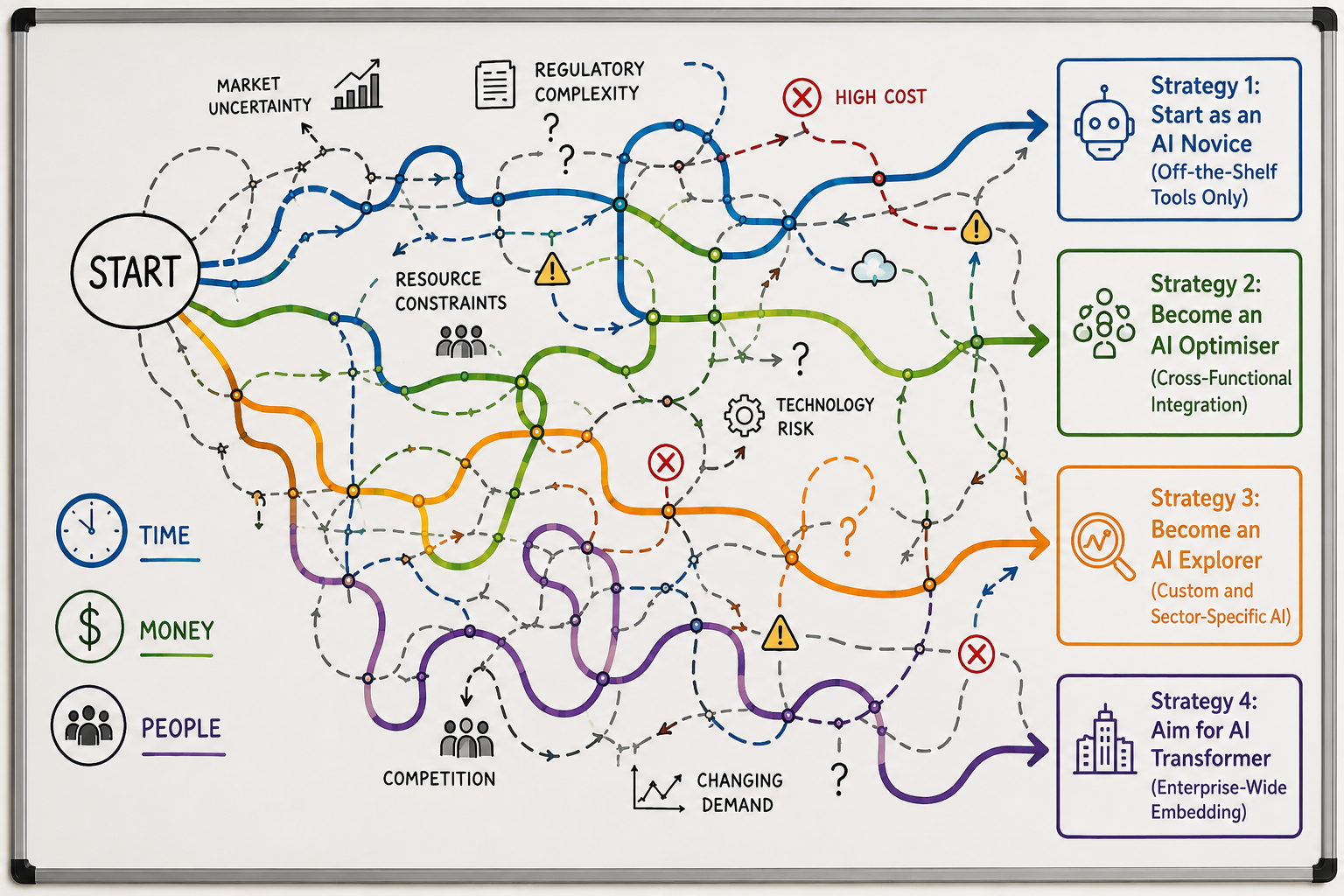
The OECD taxonomy organizes AI adoption into four profiles based on digital maturity, complexity of use, and how widely AI is applied across the business.
AI Novice. Using off-the-shelf tools (ChatGPT, Copilot) for isolated tasks — writing, marketing, simple process support. Leadership has heard about AI but no formal strategy exists. Most SMEs fall here today.
AI Optimiser. AI is used systematically across several departments. There’s coordination and some governance. Adoption covers content, customer service, and workflow efficiency.
AI Explorer. Custom AI models are being built or fine-tuned on internal data. Use cases are sector-specific. The team experiments with agents and automated pipelines.
AI Transformer. AI is embedded enterprise-wide, across operations and decision-making. In-house technical expertise exists. Infrastructure is unified.
The taxonomy matters because the right strategy — and the right costs — depend entirely on which category you’re in, or which you’re trying to reach.
Keep this in mind:
One size does not fit all: firms with varying levels of digital maturity may require different instruments to boost their capabilities and their ability to leverage the potential of AI.
Strategy 1: Start as an AI Novice (Off-the-Shelf Tools Only)
What it means
You deploy consumer-grade or SaaS AI tools directly. No custom development. No infrastructure investment. Tools include ChatGPT, Microsoft Copilot, Google Gemini, or vertical-specific tools embedded in software your team already uses.
Real example from the OECD report: a small coffee roaster in San Francisco used ChatGPT for product descriptions, SEO, marketing emails, and shipping cost analysis — entirely self-taught, no budget for specialists.
Financial cost
| Item | Estimated range |
|---|---|
| ChatGPT Team or Business | $25–$30 per user/month |
| Microsoft 365 Copilot (if already on M365) | $30 per user/month |
| Google Workspace with Gemini | $20–$30 per user/month |
| Typical annual cost for a 20-person team | $6,000–$10,000/year |
These are subscription costs only. No infrastructure. No data work. No custom code.
You can start with 5–10 users before rolling out to the whole team. Most tools have free tiers for initial testing.
Training cost
This is where companies systematically fail. The OECD found that under 30% of SMEs using generative AI report providing any AI-related training to employees. Japan is at 11.3%. Germany at 23.2%. The UK at 24%.
For AI Novice rollout, training is not optional if you want results. The research shows that firm-provided training and employer encouragement significantly boost workers’ use of generative AI and reduce demographic gaps in use (OECD D4SME Survey, 2025).
Minimum training investment at this level:
| Training type | Cost estimate |
|---|---|
| External prompt engineering workshop (half-day, group) | $1,500–$4,000 one-time |
| Online course per employee (Coursera, LinkedIn Learning AI courses) | $300–$500/person/year |
| Internal champion — one person designated to run practice sessions | Time cost: ~2–4 hours/week |
| Total for 20-person team, first year | $8,000–$18,000 |
The time cost is often underestimated. Expect 4–8 hours per employee in the first three months to reach basic competency. That’s real productivity loss during the transition period.
What the OECD calls the J-curve risk
The research documents a J-shaped productivity curve: performance may decline temporarily before it improves. Budget for this. It is normal. Teams produce less while learning. This typically lasts 4–12 weeks depending on tool complexity and training investment. Managers who don’t anticipate this tend to abandon tools too early.
What you should do
- Pick one use case with a measurable output (e.g., first draft of customer communications, meeting summaries, internal documentation).
- Run a 4-week pilot with 5 people before scaling.
- Assign an internal champion. This person does not need to be technical.
- Create a short usage guideline (2 pages maximum) covering acceptable use, data sensitivity rules, and output review requirements.
Strategy 2: Become an AI Optimiser (Cross-Functional Integration)
What it means
You move from isolated tool use to coordinated AI integration across departments. AI is used in marketing, customer service, HR, operations, and finance — not just by individuals experimenting independently.
This requires governance. You need policies on what data goes into AI tools, who reviews outputs, and how AI decisions are audited.
Financial cost
Costs increase significantly here because you’re adding coordination infrastructure, not just tool licenses.
| Item | Estimated range |
|---|---|
| SaaS AI tools (expanded seat count) | $15,000–$40,000/year for 50–100 users |
| AI governance tooling (policy management, audit logs) | $5,000–$20,000/year |
| Process mapping and workflow redesign (consulting or internal time) | $10,000–$30,000 one-time |
| Data audit and clean-up (making internal data usable by AI tools) | $5,000–$25,000 one-time |
| Total first-year investment (50-person team) | $35,000–$115,000 |
The OECD report is explicit: the cost of developing AI-ready data should not be overlooked. Most companies discover their internal data is fragmented, inconsistently labelled, or stored in formats AI tools cannot use. This cleanup is expensive and slow.
Training cost
At Optimiser level, training needs are more specific. Employees need to understand not just how to use tools, but how AI outputs feed into business processes and where human review is required.
| Training type | Cost estimate |
|---|---|
| Role-specific AI training (tailored by function: sales, ops, finance, HR) | $500–$2,000/person |
| AI literacy program for managers (decision-making with AI outputs) | $1,000–$3,000/manager |
| Change management workshops (handling team resistance) | $5,000–$15,000 |
| Ongoing skills refresher budget (tools evolve rapidly) | $200–$500/person/year |
| Total first-year training cost (50-person team) | $40,000–$100,000 |
The OECD survey data identifies the skills that become more important due to generative AI: data analysis and interpretation (cited by 46.4% of firms), creativity and innovation (41.9%), programming and coding (39%), and communication and collaboration (35.8%). Your training program should target these explicitly.
What the OECD says about resistance
Cultural and organizational resistance is one of the documented barriers at this level. The G7 Blueprint is specific: change management is essential to guide teams through AI integration transitions, address opposition, facilitate upskilling, and embed AI into everyday workflows.
Budget for this separately. It is not the same as technical training. Change management at this scale typically requires a structured program over 3–6 months, either run internally by HR with a framework or outsourced to a specialist.
What you should do
- Build an AI adoption roadmap. The OECD recommendation is explicit: company-level roadmaps should align with overall business goals and articulate where, why, and how AI will be used to drive value.
- Define a data governance policy before expanding tool use. What can employees input into external AI systems? What is off-limits (personal data, client data, confidential financial data)?
- Establish a cross-functional AI steering group. Include someone from legal, IT, HR, and one or two operational team leads.
- Set measurable targets. Productivity gains at this level typically show after 6–12 months. Firms in OECD research showed productivity premiums over 4%, with some above 15%, but only when AI was integrated into core operations — not kept at the periphery.
Strategy 3: Become an AI Explorer (Custom and Sector-Specific AI)
What it means
You begin building or fine-tuning AI models on your own data. Use cases are specific to your business context — custom agents, proprietary analysis pipelines, sector-specific classification or prediction tools.
Real example from the OECD report: a micro wholesale company in Tokyo built custom AI agents for Q&A, project negotiations, and multi-language translated chat, which increased revenues and shortened negotiation cycles.
This requires internal technical capability or reliable external partners. It is not viable without AI-ready data and at least one technically proficient person managing the work.
Financial cost
| Item | Estimated range |
|---|---|
| Cloud AI infrastructure (compute, storage, API access) | $20,000–$80,000/year |
| AI development (internal hire or external agency) | $80,000–$200,000/year |
| Data preparation and labelling | $15,000–$50,000 one-time or ongoing |
| Security and compliance infrastructure | $10,000–$30,000/year |
| Total annual investment | $125,000–$360,000+ |
The OECD report highlights a specific market problem at this level: lack of competition among cloud AI infrastructure providers has led to over-reliance on hyperscalers (AWS, Azure, Google Cloud), which makes terms restrictive and costs high for SMEs. This is a real constraint. Plan for it.
Open-source AI models (Meta’s Llama, Mistral, and others) are specifically highlighted in the G7 Blueprint as a way to reduce costs and lower barriers. These require more technical overhead but significantly reduce licensing costs.
Training cost
Technical roles at this level are expensive. The OECD is direct about this: small companies often lack sufficient resources to offer competitive salaries that help attract and retain talent, putting them at a disadvantage compared to larger companies.
| Training/talent type | Cost estimate |
|---|---|
| ML engineer or data scientist (hire or contractor) | $90,000–$180,000/year salary range |
| Advanced AI/ML certification for existing technical staff | $3,000–$10,000/person |
| Cross-functional AI training (non-technical staff working with AI outputs) | $500–$1,500/person |
| External AI advisor or mentor (part-time engagement) | $15,000–$50,000/year |
| Total first-year talent and training cost | $110,000–$240,000+ |
The OECD recommends pooled training programs as a cost-reduction mechanism — sharing training costs through industry associations, sector groups, or regional clusters. This is worth exploring specifically if you’re in a sector with a strong industry association.
What you should do
- Validate the business case before committing to custom development. The OECD documents that many companies move to Explorer level prematurely and get stuck — experiments that never scale.
- Start with one tightly scoped use case. The G7 Blueprint is explicit: successful projects begin with tightly defined problems that align with business priorities, such as cost savings, efficiency gains, or product improvement.
- Consider academic partnerships. Embedding AI talent directly within SMEs through internships, residencies, or collaborative projects with universities is a documented cost-reduction strategy in the OECD research.
- Plan for 12–24 months before reliable ROI. Custom AI development rarely produces measurable returns in under a year.
Strategy 4: Aim for AI Transformer (Enterprise-Wide Embedding)
What it means
AI is embedded across all major operations and decision-making processes. Infrastructure is unified. In-house expertise exists across functions. The business model itself may depend on AI capabilities.
Real example from the OECD report: a healthcare company in Calgary uses large language models, NLP, and computer vision for clinical note transcription and lab report analysis. A Cambridge biotech built a knowledge graph integrating 50+ data sources for drug discovery.
This level is not realistic for most SMEs in the near term. It requires years of foundation-building across the previous three stages.
Financial cost
At this level, AI is no longer a project cost — it’s an operational cost embedded in the business. Typical annual investment profiles in the OECD research context range from $500,000 to several million dollars depending on sector and scale, including infrastructure, dedicated technical teams, data operations, and compliance.
This is not a starting strategy. You reach it by progressing through the previous three stages.
Training cost
The training model at this level is continuous and embedded. The entire workforce undergoes ongoing AI skills development. The OECD frames this as a culture of continuous learning, not a one-time program.
Budget: typically 2–5% of total payroll annually dedicated to training and skills development, with AI literacy as a core component of every role’s development plan.
The Four Non-Negotiable Foundations (Regardless of Strategy Level)
The OECD and G7 Blueprint identify four enablers that are prerequisites for any level of AI adoption. These apply to you regardless of which strategy above you’re pursuing.
1. Connectivity. AI tools require high-speed, reliable broadband. If your team is distributed or includes remote workers in rural areas, audit your connectivity situation before investing in AI tooling. Fixed download speeds in metropolitan areas are 44% higher than in remote areas (OECD data, 2024).
2. Data readiness. Most companies discover their data is not AI-ready. It’s fragmented, incomplete, or stored in formats that AI tools cannot process. This is not a technical problem you can skip — it’s a prerequisite. Budget time and money for a data audit before serious AI investment.
3. Skills. The OECD survey found 50% of SMEs say employees lack the skills to use AI effectively. Training is consistently the most impactful intervention across all G7 countries surveyed. It is the single highest-ROI investment in AI adoption.
4. Governance. Concerns about harmful content (cited by over 90% of US firms), inaccurate outputs, and legal/copyright issues are reported by the majority of firms. Before deployment at scale, you need a brief but real policy: what is acceptable use, what data is off-limits, and how outputs are reviewed.
What the OECD Says About Attitude vs. Actual Barriers
This is worth reading carefully. The research found that 86% of SMEs report either neutral or favorable attitudes toward generative AI. Attitude is not the primary barrier.
The obstacles are practical: skills, cost, infrastructure, and perceived relevance. Many SMEs in Canada and the UK reported believing that AI simply wasn’t suited to their type of work.
As a mid-manager, this is your most direct challenge. The resistance you’ll encounter from your team is rarely ideological. It’s practical: people don’t know how to use it, they’re worried about their jobs, and they haven’t seen it solve a real problem they have. Address those three things specifically and directly. That’s change management.
A Checklist Before You Start
Before committing budget to any AI adoption strategy, work through these questions. They come directly from the OECD’s recommended company-level assessment framework.
- [ ] What specific business problem are we trying to solve with AI?
- [ ] What is our current digital maturity? (Are we already using cloud tools, structured data, modern software?)
- [ ] What data do we have, and is it clean and accessible?
- [ ] Who internally will own AI adoption coordination?
- [ ] What is our acceptable-use policy for AI tools, specifically regarding sensitive or confidential data?
- [ ] What is our realistic budget for tools and training in year one?
- [ ] How will we measure whether it’s working?
- [ ] What’s our plan if productivity temporarily drops during transition?
Summary Table
| Strategy | Who it’s for | Year-1 Tool Cost | Year-1 Training Cost | Time to ROI |
|---|---|---|---|---|
| AI Novice | Any team, starting out | $6K–$10K | $8K–$18K | 3–6 months |
| AI Optimiser | Teams with some AI use, ready to coordinate | $35K–$115K | $40K–$100K | 6–12 months |
| AI Explorer | Technically capable, data-ready teams | $125K–$360K+ | $110K–$240K+ | 12–24 months |
| AI Transformer | Long-term, multi-year commitment | $500K+ | Ongoing (2–5% of payroll) | 2–4 years |
Cost ranges are estimates. They vary significantly by company size, sector, geography, and specific tools chosen.
Instead of conclusions: Don’t Skip the Steps
The taxonomy in this report is not decorative. It exists because companies that try to jump from Novice to Explorer — skipping the Optimiser phase — consistently fail to embed AI into real operations. They run pilots that never scale. They buy tools that nobody uses confidently.
Each stage builds something the next one depends on: Novice builds familiarity. Optimiser builds process and governance. Explorer builds technical depth. Transformer builds organizational identity around AI.
The productivity gains the OECD documents — 4% to 15%+ at the firm level — come from companies that moved through these stages deliberately, not from companies that spent the most money the fastest.
Your people need time to understand what the tools actually do before they can use them well. That understanding doesn’t come from a product demo or a one-hour onboarding session. It comes from repeated, low-stakes practice with real work tasks — which is exactly what each strategy level is designed to provide.
Move at the speed your team can actually absorb. That’s not caution. That’s how adoption works.
Sources
Based on: AI Adoption by Small and Medium-Sized Enterprises, OECD Discussion Paper for the G7, December 2025
OECD AI Principles: https://www.oecd.org/en/topics/ai-principles.html
The SME AI Adoption Blueprint — G7 Industry, Digital and Technology Ministerial (December 2025)
Generative AI and the SME Workforce — OECD D4SME Survey (November 2025)
© Copyright 2026 Sorin Mustaca, All rights Reserved. Written For: Sorin Mustaca - Security & Technology
Want to work with me on this topic?
Check Endpoint Cybersecurity to see the consulting services we offer.


One thought on “AI Adoption for companies (based on OECD data)”
Comments are closed.