This is part 5 of 5, the last one in the Agentic Scrum series. Part 4 covered the QA agent and the test specification. This part covers the security and compliance agent, the final gate, and how to start without betting the company.

|
My company, Endpoint Cybersecurity, offers consulting on how to prepare for TISAX, ISO27001, NIS2, CSMS and SOC2 audits. It also works with companies to create and deploy a Secure Software Development Lifecycle, with various levels of AI support. |
|
||
| Get in touch with us here: https://www.endpoint-cybersecurity.com/contact/ |
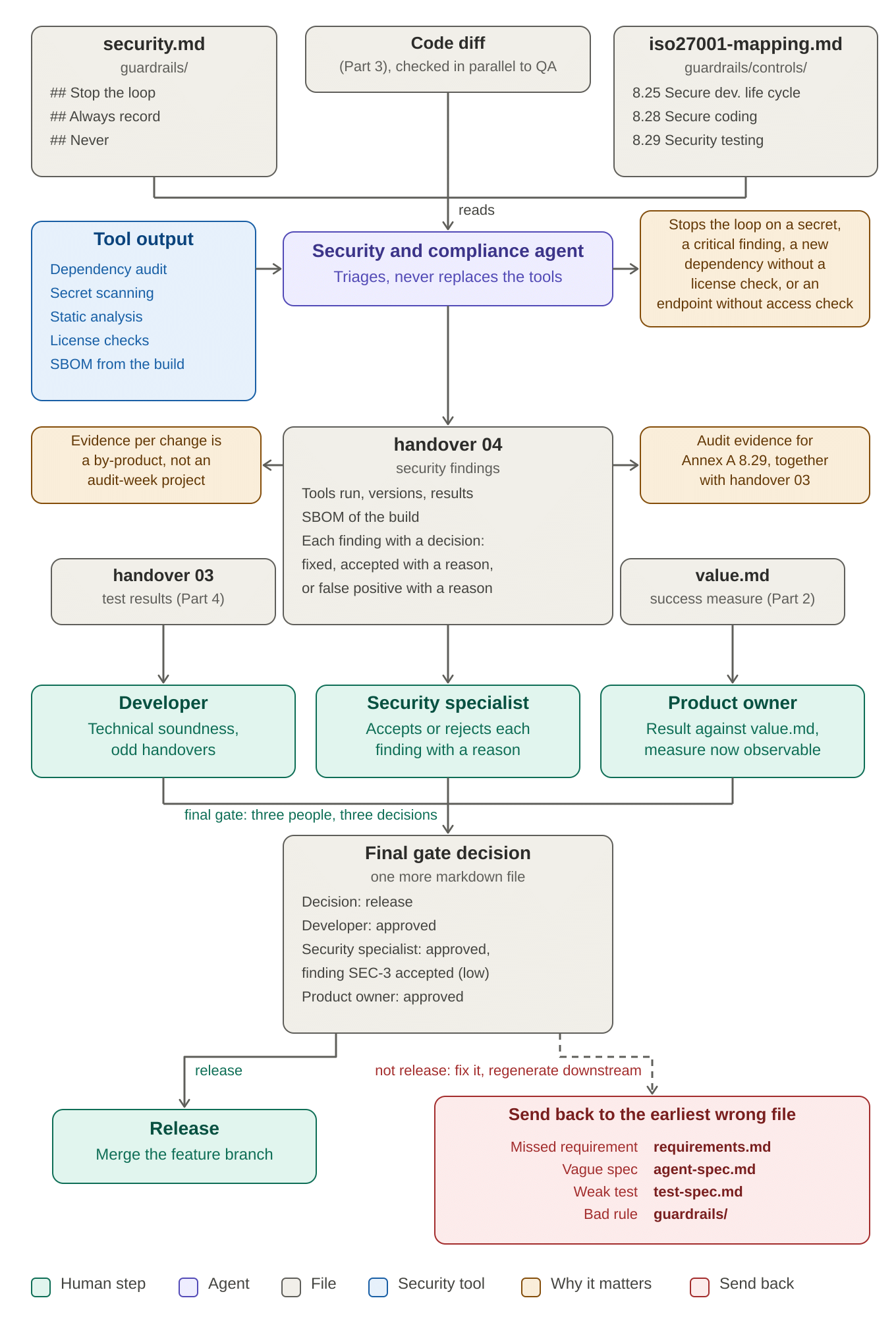
The security and compliance agent starts as soon as code exists and runs in parallel with QA. It has one rule that sounds boring and saves a lot of trouble. It does not replace your security tools.
What the security agent does and does not do
Dependency audits, secret scanning, static analysis and license checks come from dedicated tools, because those tools are deterministic and an agent is not. If you have to follow a certain security framework like ISO 27001:2022, then this is the place where you need to provide the security controls. Best is to add here a fixed set of requirements, but don’t add OWASP, NIST or similar frameworks. Just mention them, the agent will know where to find them. Of course, if you want to be thorough or want to adapt the requirements to your company’s internal policies, you can definitely add here the exact requirements.
The agent runs them, reads their output and triages it. It separates noise from real findings, links each finding to a requirement or a control, proposes what the coding loop should fix, and writes handover 04.
It also reads the diff against security.md for things scanners tend to miss, such as a new endpoint without an access check or a log line that contains personal data. This division of labor is my approach, not a standard.
The build also produces a Software Bill of Materials (SBOM), which is attached to the handover as tool output. SBOMs are important to implement the CRA requirements.
The rules in security.md
# Security rules
--
## Stop the loop
Any secret in code, config or history.
Any critical finding from dependency or static analysis.
Any new dependency without a recorded license check.
Any new endpoint without an access check.


## Always record
The tools run, their versions and their results.
The software bill of materials of the build in CycloneDX 1.6 format (JSON).
Any breach of security controls in the OWASP and NIST 800 frameworks.
Every finding with its decision: fixed, accepted with reason, or false positive.

## Never
Accept a finding silently.
Mark a finding as false positive without a written reason.
--
The “Stop the loop” section is what makes the agent allowed to break the loop, as described in Part 1. A secret in the repository is not a negotiation, and neither is a critical finding. The agent stops, writes down why, and the human who owns the problem gets it on the desk.

Controls as files, evidence as a by-product
Ok, I can’t control myself to not write about this, so I will just write about it. 🙂
Compliance usually means someone assembling evidence before an audit. Here the evidence is a side effect of the process.
A mapping file in the repository ties each control to a check and to the files that prove it.
This is an excerpt, and it is a draft to verify against your own ISMS, because the numbering follows ISO 27001:2022 Annex A, where 8.25 covers the secure development life cycle, with 8.28 on secure coding and 8.29 on security testing in development and acceptance.
# ISO 27001 mapping (draft, verify against your ISMS)
--
## Secure development life cycle (Annex A 8.25)
Check: every change has value.md, requirements.md, agent-spec.md, test-spec.md.
Evidence: the spec folder and its pull requests.

## Secure coding (Annex A 8.28)
Check: guardrails/coding.md applied, CI checks green.
Evidence: handover 02 and the CI results.

## Security testing in development and acceptance (Annex A 8.29)
Check: tests written from the test spec, security tools run.
Evidence: handover 03 and handover 04.
--
The same files help with other regimes. For the EU Cyber Resilience Act, manufacturers need vulnerability handling and, in practice, a software bill of materials, and the BSI technical guideline series TR-03183 describes cyber resilience requirements for manufacturers, including SBOM requirements.
NIS2 and TISAX both want a secure development process that operates, not just one that is described. Because every change leaves its files in git, an auditor can pick any change and walk the chain from value to release.
Confirm with your auditor that this evidence format is acceptable before you rely on it.
The final gate
When the QA and security handovers are in, the results go to three people, and each decides something different. A developer judges technical soundness and reads the handovers for oddities, such as many loops or a huge diff. The security specialist judges risk and accepts or rejects each open finding with a written reason. The product owner judges value, which means checking the result against value.md and confirming that the “how we will know it worked” measure can actually be observed now. The decision goes into one more file.
# Final gate: invoice export
--
Decision: release
Developer: approved
Security specialist: approved, finding SEC-3 accepted (low, reason recorded)
Product owner: approved, success measure reviewed after two month-ends
—
If the answer is not release, the cause decides where the work goes back to. A missed requirement goes to requirements.md. A vague spec goes to agent-spec.md. A weak test goes to test-spec.md. A bad rule goes to the guardrails. The earliest artifact responsible gets fixed first, and everything downstream is regenerated, exactly as in Part 1.
Starting without betting the company
Start with one team and one low-risk feature, within the work-in-progress cap from Part 2, and run the full pipeline including every gate. Collect numbers from day one.
The four DORA metrics are deployment frequency, lead time for changes, change failure rate and time to restore.
I would add four of my own:
- How often a spec needed rework after the agent had started,
- how many loops the agents broke and why,
- how many hours the product owner and developers spent per feature,
- how many defects escaped to production.
I have no benchmarks for those last four, so your first features are the baseline.
Two warning signs are worth watching for: Approvals that arrive within minutes and never carry a comment mean the gates have turned into rubber stamps.
And agents that never break the loop mean either the specs are excellent or the agents are guessing, so check which before you celebrate.
Previous: Part 4, Tests Are the New Code Review. This is the last part. The whole series: Part 1, Part 2, Part 3, Part 4 and Part 5.
© Copyright 2026 Sorin Mustaca, All rights Reserved. Written For: Sorin Mustaca: Security-AI-Software
Want to work with me on this topic?
Check Endpoint Cybersecurity to see the consulting services we offer.
You must be logged in to post a comment.