Intro
I talk a lot about AI these days… and I know I am not alone. People talk a lot about “agentic AI” or “AI Agents” or simply “Agents”.
During these discussions, I see there is confusion sometimes what is an Agent and what’s the difference between “AI” and “AI Agents”.

|
My company, Endpoint Cybersecurity, offers consulting on how to prepare for TISAX, ISO27001, NIS2, CSMS and SOC2 audits. It also works with companies to create and deploy a Secure Software Development Lifecycle, with various levels of AI support. |
|
||
| Get in touch with us here: https://www.endpoint-cybersecurity.com/contact/ |
Here’s the core distinction, based on how the industry defines these terms in 2026.
Chat bot
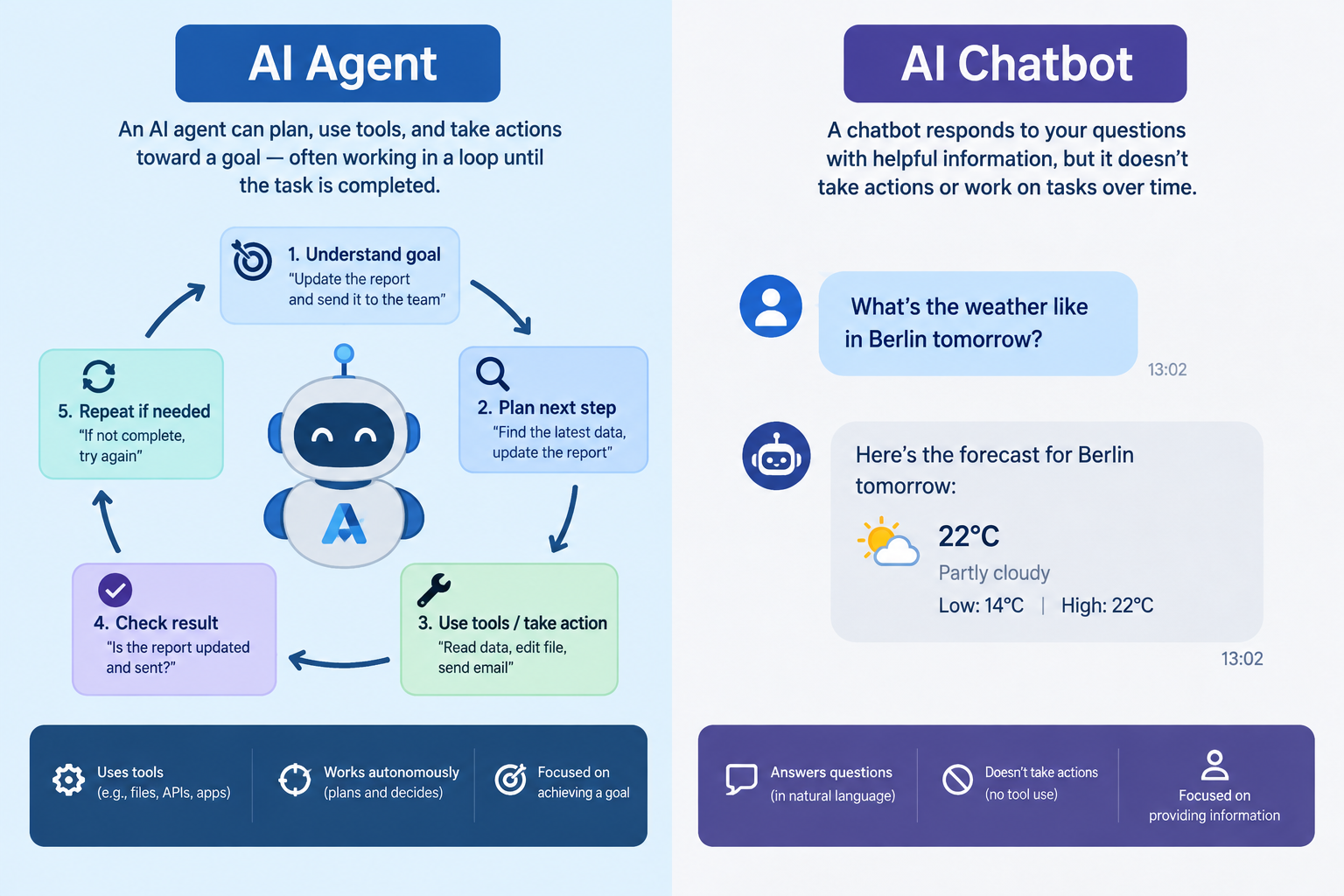
When you talk to Claude, Gemini, Grok, or ChatGPT in a standard chat window, you’re using a conversational model in single-turn or multi-turn mode.
In simple words, you send a message, the LLM reasons over the text and its training, and it returns a response.
During this process, it can search the web, run code, read a file (if that specific tool is enabled and it decides to call it), connect to an MCP server – but each of those calls is triggered inside one exchange with you.
The model doesn’t keep working after it answers. It waits for your next message. The chatbot responds to user input, it does not proactively inspect account health or take independent action.
This is usually a chatbot or what most people understand through “AI” in layman terms.
Agent
An Agent is a different mode of operation, not a different LLM.
An AI agent is a system built around an LLM that can reason about tasks, use tools, maintain memory across interactions, and execute multi-step workflows autonomously.
The LLM operates inside a loop where it observes, reasons, acts, and evaluates whether the task is done, then repeats that loop on its own until it either finishes or hits a stopping point.
So Claude Code, ChatGPT’s agent mode, and Gemini’s agentic features all run the same underlying models, but wrapped in a framework that lets the model plan a sequence of steps, pick which tool to use at each step, execute it, check the result, and decide the next action, without you approving every single move. Of course, it can be configured to ask you for various permissions, but it will decide by itself for which tools or actions to ask permissions.
Let’s compare them head to head:
- Turn structure
- Chat mode is one request, one response.
- Agent mode is a loop: the system keeps calling the model repeatedly, feeding it the results of its own actions, until the task is marked complete.
- Autonomy
- In chat, you’re in the loop for every step.
- In agent mode, the system plans multi-step tasks, decides which tools or APIs to use, executes actions across different systems, and adjusts strategies based on results with much less back-and-forth from you. It is dependent on the configuration of the agent.
- Tool access and persistence
- Chat mode can have persistence if you continue in the same conversation (same window).
- Agents are usually given broader, longer-running access to tools, files, browsers, or external systems, and they hold state across many steps of a task rather than just across a conversation.
- Goal versus instruction
- A chat interaction usually answers a specific question or does one discrete thing.
- An agent is typically handed a goal (“take this ticket, do “this”, open a PR, update documentation, trigger a build”) and works out the sequence of actions to reach it.
Is there more to say ?
Unfortunately, yes, there is more to say.
“Chatbot” and “agent” each cover a few distinct architectures, and vendors often blur the labels for marketing.
This content about Agent and Chatbot types is generated by Claude.
Chatbot types
- Rule-based chatbots run on scripted logic. A rule-based chatbot conducts conversations through predefined intent classification, entity extraction, and scripted dialogue flows, matching input against a keyword list and returning a preset response.
- LLM chatbots use a language model but no tool-use loop. The user sends a message, the system optionally pulls context from a knowledge base, and the model returns one generated response per message, with no reasoning loop or iterative execution. For example, ChatGPT, Claude, or Gemini in a standard chat window, with no tools switched on.
- RAG chatbots add a retrieval step. Before generating a response, the system fetches relevant passages from a company’s own documents or database, then feeds those to the model as grounding. Example: a support bot that answers billing questions by pulling from a company’s actual policy docs instead of relying on the model’s training data alone.
Agent types
By decision architecture
- Simple reflex agents react to the current input using fixed rules and keep no memory. Example: a basic thermostat, or a spam filter that flags an email based on fixed keyword triggers.
- Model-based reflex agents keep an internal picture of the world and react based on that. Example: a robot vacuum that builds and updates a map of a room as it cleans.
- Goal-based agents plan a sequence of actions to reach a stated goal. Example: an LLM-based agent told to “get this bug fixed and open a pull request,” which breaks that into finding the file, editing it, running tests, and submitting the PR.
- Utility-based agents weigh tradeoffs, such as cost against speed against quality, rather than just reaching any goal state. Example: an agent picking between three ways to complete a task based on which uses the fewest tokens or the least time.
- Learning agents improve their own strategy from feedback over repeated use. Example: an agent that adjusts which search queries it tries first based on which ones succeeded in past runs.
By system architecture
- Single-agent systems have one LLM controller handling planning, tool selection, and execution on its own. Example: Claude Code working through a coding task step by step, or ChatGPT’s agent mode browsing and filling out a form.
- Hierarchical agents split work into subgoals, with a manager agent assigning pieces to worker agents. Example: an orchestrator agent that hands research to one sub-agent and drafting to another, then merges the results.
- Multi-agent systems have several agents that communicate and coordinate, sometimes with different roles. Example: a setup where one agent writes code, a second reviews it, and a third runs the test suite, passing results back and forth.
By application role
This is the practical category most people mean when they say “agent” in a product context: coding agents, customer-service agents, research agents, and browser agents, each built around the same core loop but pointed at a specific job.
Conclusion
“Agent” is used veeeery loosely across the industry right now, and there’s no single technical standard everyone agrees on.
Some products labeled “agent” are close to a chatbot with a couple of extra tool calls, and some are genuinely running long autonomous loops.
A lot of products marketed as “AI agents” don’t actually run the full Observe-Reason-Act-Evaluate loop. Of the thousands of vendors claiming agentic capabilities, only a small fraction offer systems that genuinely plan and act autonomously across multiple steps,
and the rest are closer to chatbots or fixed workflows with agent branding.
So the label on a product doesn’t always match the architecture underneath it – when you see a product call itself an “agent,” check what it actually does rather than taking the label at face value.
© Copyright 2026 Sorin Mustaca, All rights Reserved. Written For: Sorin Mustaca - Security & Technology
Want to work with me on this topic?
Check Endpoint Cybersecurity to see the consulting services we offer.

One thought on “AI Q&A: what is an Agent?”
Comments are closed.