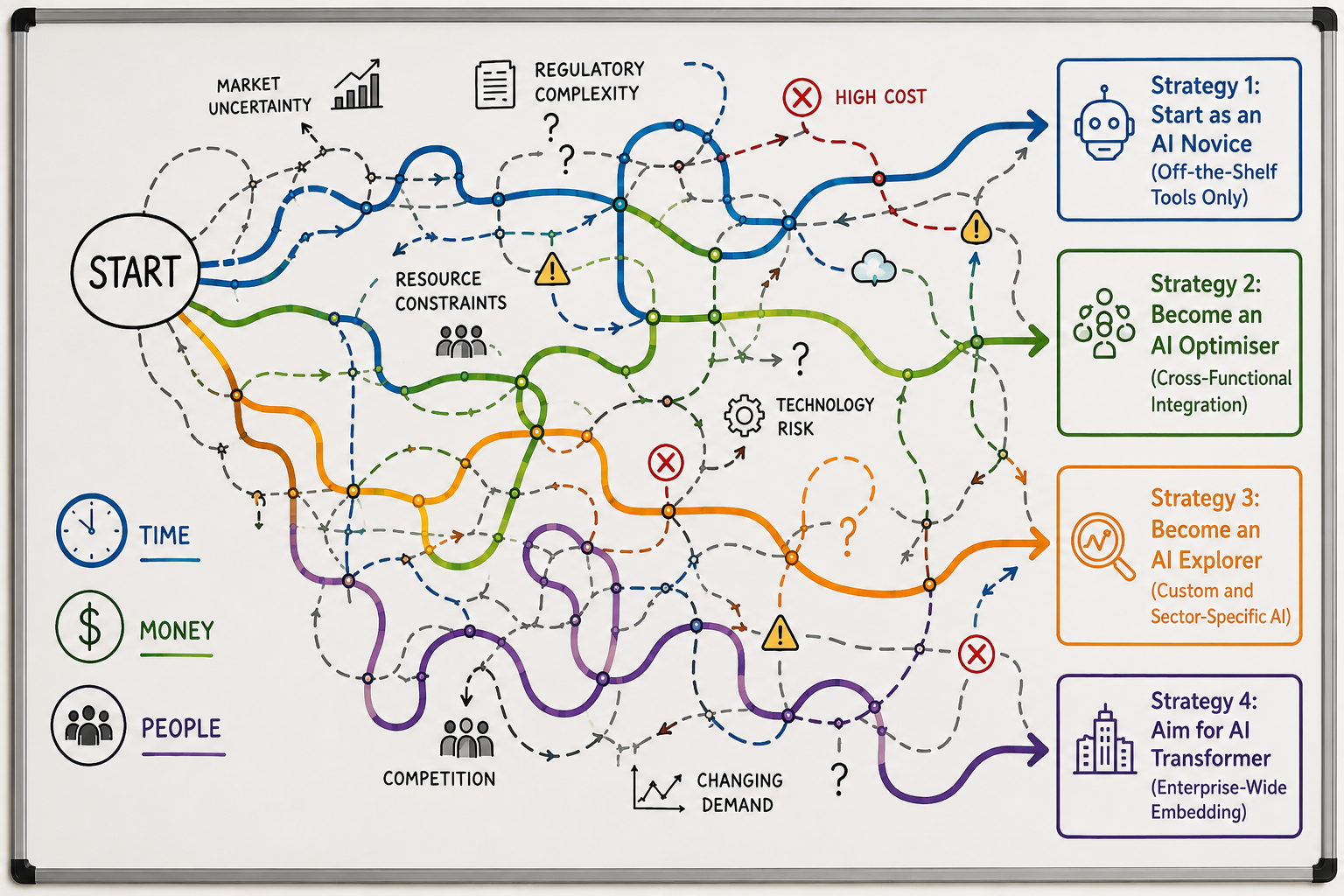
This is the extension of the original article AI Adoption for companies (based on OECD data)
What US Companies Are Actually Spending — And Where It Maps
The OECD data gives you the strategic framework. US-specific data gives you a reality check on spending. Here is what verified US sources report.
Adoption in the US right now
The US picture differs from the OECD aggregate in one notable way: adoption is accelerating faster than the global average, but the distribution is highly uneven.
The SBA’s Business Trends and Outlook Survey (BTOS) — which draws on Census Bureau data — found that small business AI usage rose from 6.3% in February 2024 to 8.8% by August 2025. Large firms (250+ employees) were at 11% as of February 2025 by the same measure. This is a narrower gap than the OECD’s global data, where large firms are at 40%. The difference reflects measurement methodology: the BTOS captures active business-function use, while the OECD counts any AI tool use.
The U.S. Chamber of Commerce uses self-reported surveys and gets higher numbers: 58% of small businesses said they use generative AI in 2025, up from 40% in 2024 and 23% in 2023.
These figures are not contradictory — they reflect different definitions of “using AI.” The SBA measures structured business-function deployment. The U.S. Chamber captures self-identified use of any generative AI tool, including consumer apps.
For practical planning purposes, the SBA/BTOS data is more conservative and likely more relevant to real operational deployment.

|
My company, Endpoint Cybersecurity, offers consulting on how to prepare for TISAX, ISO27001, NIS2, CSMS and SOC2 audits. It also works with companies to create and deploy a Secure Software Development Lifecycle, with various levels of AI support. |
|
||
| Get in touch with us here: https://www.endpoint-cybersecurity.com/contact/ |
What US firms are spending per employee
The most useful spending data comes from a May 2026 Federal Reserve Bank of Atlanta study, based on a survey of senior US business executives conducted in March 2026.
Key findings:
– US firms spent $1,358 per employee on AI in 2025 (includes software, subscriptions, hardware, training, and IT support)
– That figure is expected to rise to $2,068 per employee in 2026 — a 50% increase year-over-year
– Aggregate private-sector AI investment is estimated at $280 billion for 2026, consistent with a separate Stanford HAI estimate of $285 billion
The distribution matters here. The median firm expects to spend no more than $200 per employee in 2026. The top 10% of firms plan to invest at least $2,800 per employee. That is a 14-fold gap between the median and the leading adopters.
This matches the OECD’s warning exactly: most companies are not spending meaningfully. The average is pulled up by a small number of large, aggressive adopters.
How US spending maps to the four strategies
| OECD strategy level | Typical US company profile | Implied spend/employee (Atlanta Fed) |
|---|---|---|
| AI Novice | Most US SMBs today | ~$200 or less (median firm) |
| AI Optimiser | Active adopters, multi-function use | $500 – $1,500 |
| AI Explorer | Knowledge-intensive sectors (professional services, finance) | $2,000 – $3,500 |
| AI Transformer | Top 10% of firms, enterprise-wide deployment | $2,800+ |
Source: OECD taxonomy (December 2025) mapped to Federal Reserve Bank of Atlanta spending data (May 2026). Spend figures include software, subscriptions, hardware, training, and IT support.
Note: The spend figures are labeled “implied” because the Atlanta Fed reports a per-employee average across all firm sizes — the mapping to OECD tiers is a reasoned connection, not a direct quote from either source.
The median ($200 or less) is explicitly sourced from the Atlanta Fed’s own finding that more than half of respondents expect to spend no more than $200 per employee.
The professional and business services sector is expected to spend $3,470 per employee in 2026 — a 74% increase from 2025. Manufacturing sits at the opposite end at approximately $900 per employee.
Construction, hospitality, and transportation are likely below even that, consistent with the OECD’s sectoral findings.
The training gap in the US
The Atlanta Fed data confirms the OECD finding on training. When firms were asked what their AI spending covers, training was included but represents a small share of total spend for most companies. The same SBA research found that skills gaps remain the primary adoption barrier, affecting 46% of US business leaders (McKinsey data, cited by SBA).
The U.S. Chamber found that concerns over cost, compliance, and workforce readiness are the top three persistent barriers — in that order. Workforce readiness is a training problem. It does not resolve itself with more tool licenses.
The US-specific warning on attitude vs. spending
The U.S. Chamber found that 96% of small business owners plan to adopt emerging technologies including AI.
That intention figure is strikingly high. But intention and spending are not the same thing. The SBA/BTOS data shows actual structured deployment at 8.8% for small firms.
The gap between 96% intent and 8.8% deployment is the execution problem. It is the same problem the OECD documents globally.
Companies announce AI plans. Most stay at Novice level or never deploy meaningfully. The reason, consistently, is the same: no training program, no governance, no assigned owner, and no defined use case.
Sources
OECD & G7
- AI Adoption by Small and Medium-Sized Enterprises — OECD Discussion Paper for the G7 (December 2025)
- The SME AI Adoption Blueprint — G7 Industry, Digital and Technology Ministerial (December 2025)
- Generative AI and the SME Workforce — OECD D4SME Survey (November 2025)
US Federal & Government Sources
- How Much Are Firms Spending on AI (and What Will Happen to Headcounts?) — Federal Reserve Bank of Atlanta (May 2026)
- Research Spotlight: AI in Business — Small Firms Closing In — SBA Office of Advocacy (September 2025)
- AI Can Improve US Small Business Productivity — ITIF (April 2025)
U.S. Chamber of Commerce
© Copyright 2026 Sorin Mustaca, All rights Reserved. Written For: Sorin Mustaca - Security & Technology
Want to work with me on this topic?
Check Endpoint Cybersecurity to see the consulting services we offer.

One thought on “AI Adoption for companies in the USA”
Comments are closed.