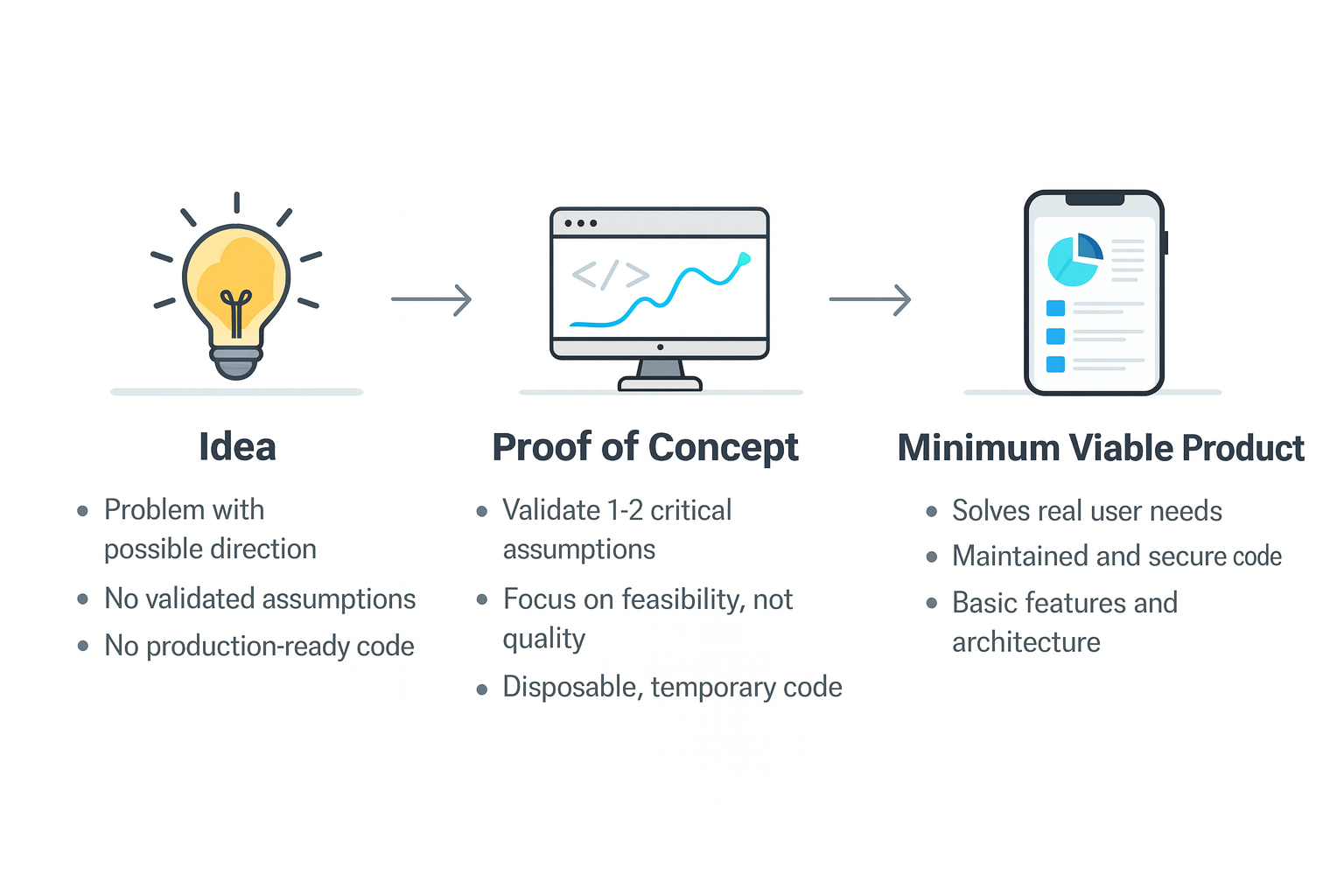
This is a a developer focused guide in three parts to evolving code, architecture, and processes with the purpose of turning a raw concept into a usable product. This process is one of the hardest parts of software development.
Teams often jump into implementation too early, or they build something polished before testing whether the underlying assumptions hold.
A structured flow—Idea → Proof of Concept (POC) → Minimum Viable Product (MVP)—keeps this journey predictable and reduces waste.
Each stage exists for a specific reason, and each stage demands a different mindset about code quality, design rigor, and security.
For developers, this is also a shift in how code is written, reused, refactored, and prepared for production.
This article explains the journey from the perspective of engineering teams, with practical backend and frontend examples and a clear separation of security activities.
1. The Idea Stage
The idea stage is where the team defines the problem and shapes the first version of the solution direction. The discussion is broad, and uncertainty is still high.
At this point the team is not writing code in any meaningful sense, but rather exploring possibilities, boundaries (technological, legal, usability related), and early risks.
The goal here is not to “design the whole system”. The goal is to understand whether the idea is worth testing and whether the technical foundation appears feasible. This prevents teams from sinking time into something that cannot work or is not worth the investment.
What Makes This Stage Unique
The idea stage is low-cost, low-risk, and exploratory. Developers participate mainly by assessing feasibility, identifying potential architectural constraints, and sketching which components might be reused later. The conversation stays intentionally shallow. Nothing should be implemented that the team cannot abandon without regret.
Inputs and Outputs
Inputs include the product need, early UX sketches, discussions about the problem, and high-level constraints such as data privacy, integration requirements, or performance expectations.
Outputs include a defined problem statement, a preliminary solution outline, and a clear hypothesis that the POC must validate.
Actors
Product managers frame the problem. Engineering leads assess feasibility. UX designers shape initial user interactions. Security architects provide early warnings about potential data-handling or compliance pitfalls.
Engineering Expectations at This Stage
Code and Architecture
No production code is written. If developers create anything, it is lightweight and disposable:
simple mock APIs written in Postman collections, small HTML/JS mockups, or rough OpenAPI drafts.
Nothing created at this stage is meant to be reused directly, but these drafts help teams align on concepts.
However, developers should already think about potential reuse paths.
For instance, if the solution will likely need a shared data-access layer or a reusable front-end state-management module, this is the time to name those opportunities—even if nothing is implemented.
Process Implications
The team documents assumptions, potential dependencies, and cases where reuse might save time later.
There is no review process, no CI pipeline changes, and no branching strategy decisions.
This remains a design and exploration stage.
Backend Example
A backend developer might sketch a future architecture in AWS or draft a sequence diagram showing how the system would communicate with an external payment service.
They might explore the integration constraints by reading documentation and checking rate limits, but no or very little code is produced.
Frontend Example
A frontend developer might draft wireframes and map out how new UI states could fit into existing structures.
They might also check whether existing UI components can be repurposed to avoid re-inventing layout patterns later.
Security and Privacy
Security work is limited to conceptual analysis. No real data is supposed to be used in this stage, so privacy concerns should not exist.
Security architects identify which data categories will be processed, assess whether regulatory frameworks apply, and highlight technical constraints that must be tested in the POC.
No security implementation takes place at this stage, but early awareness helps avoid blind spots later.
Here is the article of the next step: Proof of Concept: https://www.sorinmustaca.com/from-idea-to-proof-of-concept-to-mvp-the-poc-stage-2-3/


7 thoughts on “From Idea to Proof of Concept to MVP: The Idea stage (1/3)”
Comments are closed.