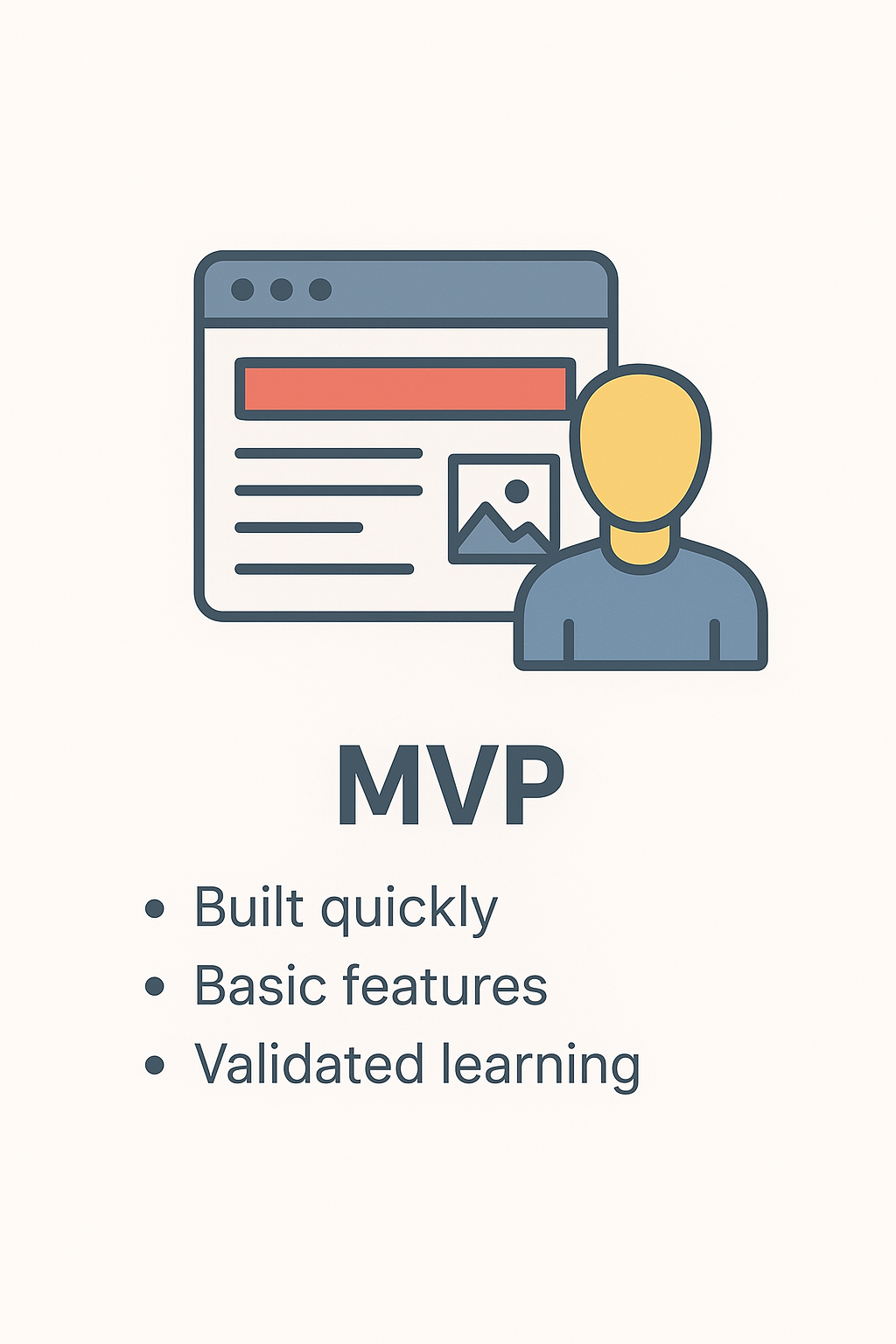
We continue the series of 3 articles with the second one, about the Minimum Viable Product (MVP).
Here is the first article in the series, From Idea to Proof of Concept to MVP: The Idea stage (1/3) and the second article, the From Idea to Proof of Concept to MVP: The POC stage (2/3) .
3. The Minimum Viable Product (MVP)
Once the team has validated feasibility, the work shifts to building a usable, reliable product with a minimal but complete set of features.
The MVP is the first version that serves real users and collects real feedback.
Code quality, architecture, and processes now matter because the MVP becomes the foundation for all future iterations.
Purpose and Scope
The MVP implements the core value with enough stability, scalability, and security to run in production.
It does not include every possible feature—only the essentials—but it must be well-engineered.
Inputs and Outputs
Inputs include the validated POC, UX designs, refined requirements, and mandatory security needs.
Outputs include a deployable product, operational metrics, user feedback, and a backlog for enhancements.
Actors
The full engineering team is involved: backend, frontend, QA, DevOps, Security, UX, Product, and Operations.
Cross-team communication becomes essential, because making the MVP stable requires alignment across all disciplines.
Engineering Expectations at This Stage
Code Quality and Reuse
Developers now take the core logic from the POC and turn it into production-ready modules.
This involves consistent naming, clear responsibilities, robust error handling, schema validation, and test coverage.
The team extracts reusable libraries, shared components, or service interfaces to avoid future duplication.
The MVP becomes the beginning of a long-term codebase.
Required Technical Changes
-
Transform API drafts into versioned, documented REST or GraphQL interfaces.
-
Move throwaway scripts into properly structured modules or services.
-
Add input validation, sanitization, and schema enforcement.
-
Introduce unit tests, integration tests, and E2E tests.
-
Replace temporary mock data with real data pipelines.
-
Add observability: logs, metrics, traces, dashboards.
-
Integrate with continuous delivery pipelines.
Process Evolution
The team adopts formal processes:
- CI/CD, code reviews with defined guidelines, branching strategies, automated testing, deployment checklists, and observability standards.
- Documentation becomes mandatory because the product is no longer experimental.
Backend Example
The recommendation engine becomes now a stable service.
The POC endpoint turns into a versioned API with full request validation, structured logging, retry logic, error mapping, and test coverage.
The integration with the ML service now uses proper authentication, rate limiting, and timeouts.
Monitoring dashboards track latency, throughput, and error rates.
Frontend Example
The rough POC component becomes part of the application’s design system.
It uses reusable UI components, handles loading and error states gracefully, and integrates with the global state store.
Unit tests confirm component behavior, tests validate the full user flow.
Telemetry captures user interactions so the team can validate assumptions after launch.
Security
Security now moves from conceptual and experimental checks to real, enforceable controls.
This includes:
-
Authentication and authorization integration
-
Input validation and output encoding
-
Protection against injection vulnerabilities
-
HTTPS enforcement and secure cookie settings
-
Audit logging
-
Secrets management
-
Data-handling guarantees for sensitive information
The MVP does not need every advanced security feature, but it must meet the minimum standards required for production—especially if it processes personal or regulated data.
Here is the first article in the series, From Idea to Proof of Concept to MVP: The Idea stage (1/3) and the second article, the From Idea to Proof of Concept to MVP: The POC stage (2/3) .
2 thoughts on “From Idea to Proof of Concept to MVP: The Minimum Viable Product – MVP (3/3)”
Comments are closed.