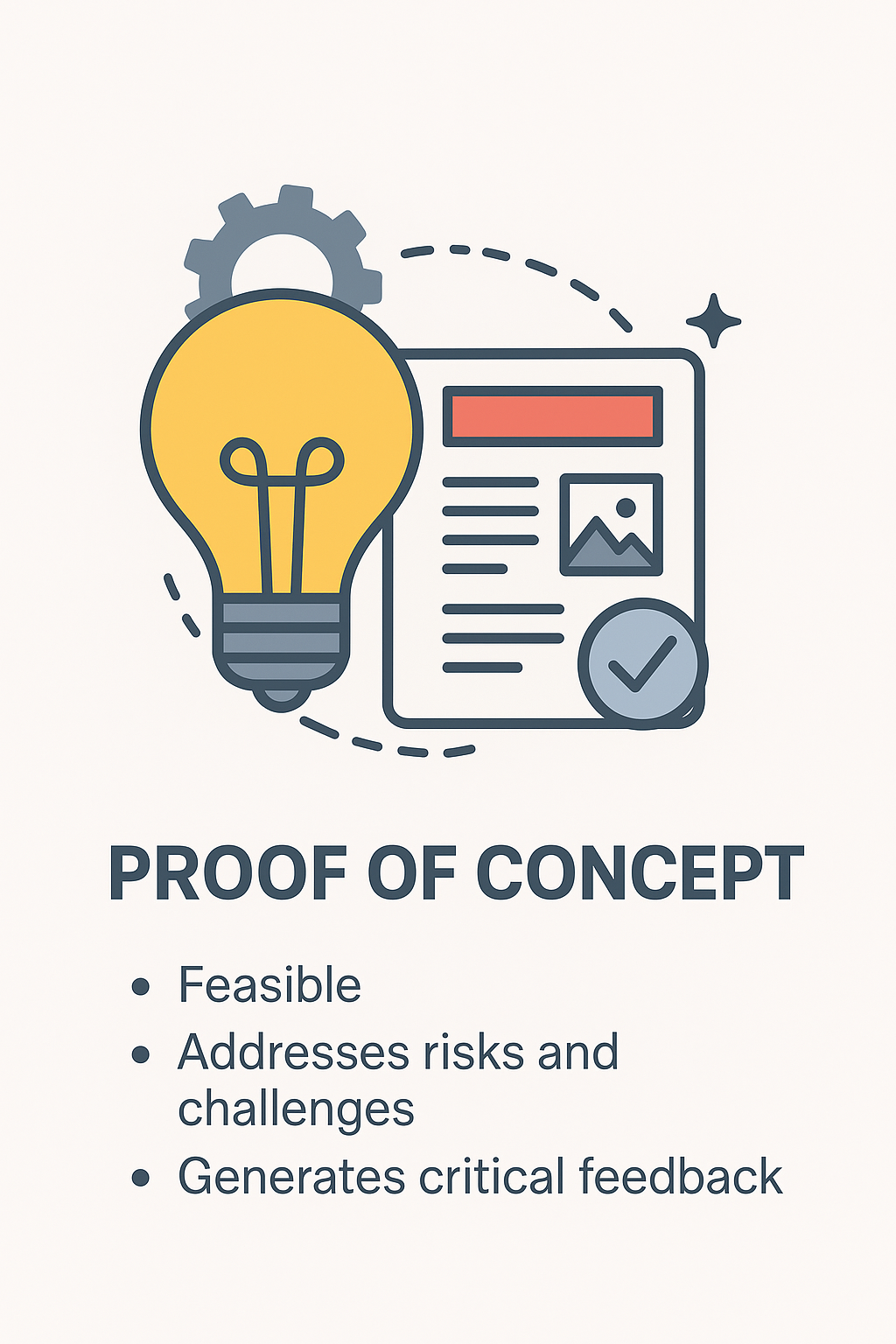
We continue the series of 3 articles with the second one, about the Proof of Concept (POC).
Here is the first article in the series, From Idea to Proof of Concept to MVP: The Idea stage (1/3) .
2. The Proof of Concept (POC)
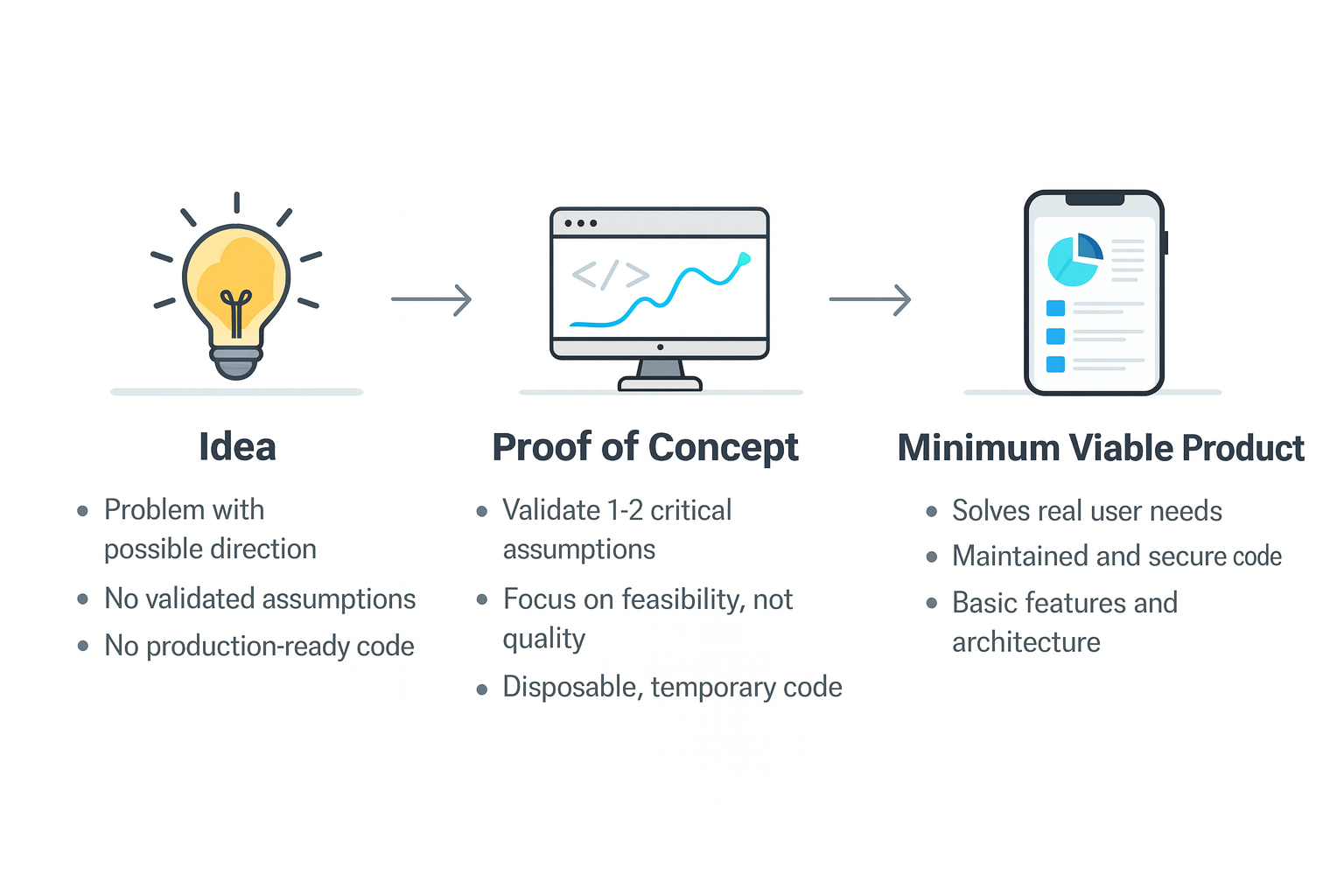
The POC is where the team tests a specific risky assumption that could make or break the idea.
The aim is not to build a usable product but to verify that a key technical, architectural, or data-processing challenge is solvable.
POC code is intentionally imperfect. It moves fast and cuts corners. However, it should still be written in a way that reduces friction when extracting reusable parts for the MVP.
What Defines a POC
- A POC is short-lived and narrowly focused. It often tests only one or two questions:
Can we integrate with this external system? - Can this algorithm scale?
- Can the frontend render a dynamic timeline with the required performance?
The purpose is to generate a clear yes/no answer, not to produce a polished outcome.
Inputs and Outputs
Inputs include the problem statement and hypothesis defined in the idea stage.
Outputs include a working demonstration, documentation of findings, architectural constraints, and a clear decision: continue, pivot, or stop.
Actors
Developers implement the experiment.
Tech leads help evaluate results.
QA may help with validation but does not perform full product testing.
Security engineers review risks that appear during the experiment.
Engineering Expectations at This Stage
Code and Reuse
POC code is disposable, but that does not mean it should be sloppy. Developers should write code that can be extracted later without major re-architecture. This typically means:
-
Avoid hardcoded credentials, external URLs, or secrets.
-
Organize files in a simple but meaningful structure.
-
Implement the core logic in isolated modules instead of burying it inside an ad-hoc script.
-
Use interfaces or adapters to make future dependency injection easier.
The mindset should be: “This code may be thrown away, but if it works well, we want to reuse pieces of it.”
What Must Change Later
Before integrating POC code into the MVP, the team will need to refactor it: add error handling, consistent logging, tests, and proper abstractions.
In other words, the POC shows the core idea works, but the MVP requires turning this into real engineering.
Process Evolution
The POC often introduces small process steps such as:
-
Lightweight code reviews
-
A temporary branch in the repository
-
Simple build scripts to allow teammates to run the demonstration
This is still not production engineering. CI/CD pipelines and test automation usually come only at the MVP stage.
Backend Example
Suppose the team is building a new recommendation engine.
The backend POC might implement a single endpoint that forwards a request to an external ML service and measures latency and response quality.
Logging might be minimal, validation might be non-existent, and error handling might be crude—but the team learns whether the external ML service meets the performance requirements.
Frontend Example
A frontend POC might involve building a rough React component that displays personalized recommendations using mock data.
The component may not follow the design system, may not handle loading states cleanly, and may ignore error cases.
The goal is to check whether the UI interaction model feels intuitive and whether the state updates behave as expected.
Security
Security engineers examine how the POC handles sensitive data, even if the handling is mocked.
They validate risky paths such as authentication flows, data transformation logic, or external integrations.
The POC must identify whether the solution will require additional compliance measures, encrypted storage, or stricter authentication schemes.
This becomes a mandatory input for the MVP.

6 thoughts on “From Idea to Proof of Concept to MVP: The POC stage (2/3)”
Comments are closed.